Grandma & Grandpa's Farm
Showing posts with label science. Show all posts

Saturday, September 6, 2008

What a Body Count -- an ultimate lineup

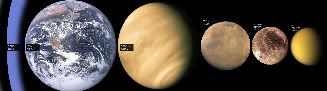
All Known Bodies in the Solar System Larger Than 200 Miles in Diameter -- to scale lined up in a row.

Perhaps you have to be a science or astronomy buff -- or into science fiction -- but I found the content of this web page incredible. It is not so much that there is a lot of new information nor that any great high tech or fancy web tricks are being used. It is merely that it is interestingly laid out and in a way that even a layman can appreciate -- I think.

The page is: KOKOGIAK -- All (known) Bodies in the Solar System Larger than 200 Miles in Diameter. It was posted March 29, 2007 and so a little bit out of date, but not so much as it can't be enjoyed and appreciated.


Of course this is only a thumbnail of the original. The original is 1000 pixels high or tall enough that the Earth -- that first blue marble to the left -- should be approximately screen height on most monitors. To make it reasonable in size the creator -- and I believe it is the Website Developer, Alan Taylor, decided to scale things to the height of the Earth. He is representing the larger planets by showing a section of their "limb" -- an arc of the edge of their disk -- to give an impression of their relative size. Otherwise the smaller bodies would shrink to insignificance. His choice of 200 miles as being a cut-off is that it is the approximate size of Mimas (247 miles in diameter) and he is fond of this satellite of Saturn's.

I think he made a good choice. I think one can scroll horizontally across one of the three choices of views of the image. One has the metric and Imperial measurements for the planet's diameter along with the name, the next is the same image, but with only the metric measurement, the last has the image without any text labels. I have a bit larger scale image cropped here as a thumbnail to give a slightly better feel for things. (image to left -- image from KOKOGIAK) This is still much smaller than the actual image.

It does use actual images where possible. I think the only place where I might criticize is with regard to Venus and that the image he uses seems to be dilated horizontally somewhat even if you take into consideration the fact that part of its disk is in shadow like Titan's is. I do believe that the artist -- for I do believe it is artful -- tried for teh colours you might see with the naked eye, or some semblance of them.

If you are at all interested in the Solar System -- whether you agree with Pluto's current designation or not -- I recommend you go to this page and have a look at the presentation of this image. I don't think you'll be disappointed.

More information on KOKOGIAK can be found on their main page http://www.kokogiak.com/default.asp. I suggest you have a look at the window below where the title "KOKOGIAK" is written and click on the menu items for "Who" "What" and "Where" to find out more about the site. I think I'll be having more of a look there.

Later!
~ Darrell

133.


DailyStrength - Free Online Support Groups

Sunday, August 24, 2008

Surge's Up!

Look Ma! No Wires!

Something I have just come across on the technology news is something demonstrated by Intel -- a wireless power system!

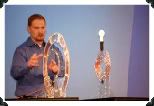
Their demonstration involved a stand with a 60-Watt light bulb powered by their magnetic resonance technique. This technique uses a tuned coil to resonate with the same frequency as that of the oscillating magnetic field in the power source. (image to left -- image from Daily Tech¹)

Intel demonstrated the system August 22, 2008² with the 60-Watt bulb possibly because it "...uses more power than a typical laptop computer."² While transmitting power has been possible with different technologies since the times of Nikola Tesla -- back before power-lines crossed the countryside. ...Tesla came up with the technique of AC power.

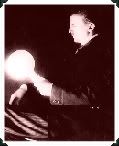
Nikola Tesla was looking for ways to transmit power over long distances; thinking that nobody would be interested in laying grids of power lines across city and countryside. Of course we now now different with our cities and countrysides criss-crossed with networks of powerlines carrying Tesla's multi-phased AC current. Image to right of Nikola Tesla demostrating wireless power transmission. (image to right -- image from Serbia the Golden Apple³)

The Intel demonstration however was of shorter range and not intended for sending power across the city, rather its intent is to power devices within the home or office without wires. It might only mean not having to plug in your cell phone, but it charging whenever at home or in the office -- or perhaps being able to use your notebook computer anywhere in the house or office without draining the battery and without needing to plug in... ever.

Another area is peripherals for the computer. Consider wireless keyboard and mouse which will never need you to replace or recharge a battery. I have been writing about cell phones and computer stuff -- perhaps focusing on it because I am writing this article on a computer and that was what they talked about in the article. Perhaps this is also because Intel is aiming in this direction. There are likely many other applications that you and I can discover.

I wonder if there are medical possibilities for keeping artificial hearts and other devices charged and running? The main power-source kept outside transmitting power to the device - magnetically coupled to the source outside?


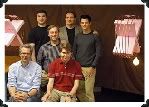
MIT team and their setup to power 60 Watt bulb. (image to left - image from MIT News Officeª)

The efficiency of the demonstration system with the light bulb was only 75% efficiency at around a metre distance so you might not want to think about tossing away every power-cord. On the other hand, you might be able to have power stations for certain tasks... like for instance your desk might have one and all the computer equipment and peripherals might be powered by a local station in the desk. That might include charging your PDA, cellphone, mp3 player, notebook computer, portable hard drive and similar equipment as well as powering the mouse, keyboard, and other equipment without any cords crisscrossing the desk.

Still I think you might have some resonant frequencies for the desk, kitchen, entertainment unit, and...

Of course... there are always the spectres of health issues. They say that the interaction at the frequencies used with biological materials is minimal... but how minimal is minimal and what effects might there be? People are starting to consider the growing background of microwave radiation we are being bathed with even if we don't use cellphones, cordless phones, or wireless networking. Perhaps those people who line their hats with tin foil might have a good idea.

Later!
~ Darrell

125.

__________
¹ "Intel Demos Bizarre Tesla-esque Wireless Power Transmission System" Jason Mick (blog) August 22, 2008 - Daily Tech.

² "Intel demos wireless power system" AFP August 22, 2008 - Canada.com.

³ "Genius From Smiljan" Serbia the Golden Apple - Nikola Tesla (Serbia).

ª "Goodbye Wires... - MIT News Office" MIT news.

Other links: "Travelling magnetic field for homogeneous wireless power transmission"; "Technology Review: TR10: Wireless Power".

DailyStrength - Free Online Support Groups

Thursday, August 7, 2008

Pick a Peck of Planets, Why Not Pluto?

Why Isn't Pluto Still a Planet?

Pluto hasn't shrunk really, though perhaps it is smaller than we thought it was. The main thing is that the Solar System became more populated -- in particular beyond the orbit of Neptune. There have been a number of large spherical bodies similar to Pluto which have now been discovered beyond the orbit of Neptune and Pluto. (They now want to refer to Pluto as 134 340)

The mass of Pluto was determined and it was found to be a body of mostly ice as well as being small. The mass could be determined because it was discovered that Pluto had a satellite -- Charon. By determining the orbital period of Charon and knowing the distance between the Pluto and Charon they calculated the mass of the two bodies. Pluto's mass and structure is much different from Mercury which is the smallest planet excluding Pluto.

It wasn't the size or mass that meant the change in status, but the fact that there are a number of other bodies in the area of the orbit of Pluto. The fact that there are other objects -- smaller ones even -- in the orbit of Pluto, in its "orbital neighbourhood" (Approximately 1000 objects in the Kuiper belt to date.) that it has been demoted from planetary status.

It was with the discovery of the large bodies up to the size of Pluto and even larger in the extra-Neptunian space of the Kuiper Belt that Astronomers felt a need to come up with an astronomical definition for "Planet".* The International Astronomical Union (IAU) came up with this definitions that in the solar system a planet is a celestial body that:

A Planet**

  • is in orbit around the Sun
  • has sufficient mass so that it assumes a hydrostatic equilibrium (nearly round) shape
  • has "cleared the neighbourhood" around its orbit

There was originally consideration of creating "dwarf planets" as a subset of "planets" however this was dropped because it would lead to the addition of several dozen planets in the Solar System.* That would have started off with the Asteroid Ceres, Pluto, and the Trans-Neptunian bodies Makemake and Eris**.

Non-satellite celestial bodies in the Solar System have been classified as "Planets" "Dwarf Planets" and "Small Solar Bodies".

Dwarf Planet**

  • is in orbit around the Sun
  • has sufficient mass so that it assumes a hydrostatic equilibrium (nearly round) shape
  • has not cleared the neighbourhood around its orbit
  • is not a satellite

I assume that the "is not a satellite" is assumed with Planets.

Small Solar System Bodies**

  • all other objects except satellites, orbiting the sun
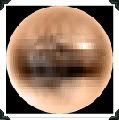
Personally I think the definition is a bit short sighted. I think too much is based on location of the celestial body and so does not directly account for the hundreds of extra-solar planets that have apparently been discovered around other stellar bodies. I think also that there is a bit of underestimating of people with some sort of fear of their being more than 9 planets... more than 12... (Pluto, image to left -- image from Wikipedia)

Consider this while there are 10 provinces and 3 territories in Canada and 6 states in Australia, (hoping I have that right there have been some changes since I graduated from high school) there are 50 states in the United States. I don't think anyone considers redefining what a "state" is in the US in order to reduce the number of states.

Perhaps there does need be classifications of types of planets? We already do that with "gas giants" "terrestrial planets" "ice planet" and perhaps "super earth" and "hot jupiter". We might add "dwarf planet" or others?

Celestial bodies might be defined in a few ways -- by tradition, religion, and politics; by location and orbital dynamics; by mass, radius, and composition; or perhaps others... While there is perhaps some politics in the IAU decision it seems based on orbital dynamics and mass. That is fairly reasonable.

I do think perhaps a bit short sighted. I think that a person has to look at what is important. Why are we defining what a planet is? If the point is to limit what is called a planet to 8 or 9 bodies, then the definition that was decided on works. If the definition is to classify celestial bodies, I think they could do better. Definitions based on structure and composition would be far better to my mind. Orbital dyanmics might be important for locating and organizing planets when we have a large number of them.
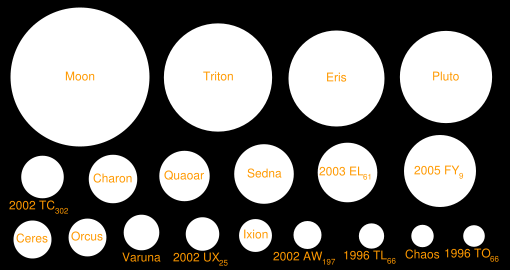

Image above shows a size comparison between Earth's Moon, Neptune's Moon Triton, and several large Trans-Neptunian Objects (TNO). Note that 2005 Fy9 is now known as Makemake with Eris, Pluto, and Makemake being the largest three TNO known thus far and the ones they were speaking of as being in that subset of planets. -- Image from Wikipedia - Trans-Neptunian objects

My own personal bias says, if I were to stand on it or were in orbit around it, would I think it was a planet? Would I think I were orbiting it or orbiting with it? I was going to say "If I were standing on it, would I feel if I were on a planet?" but of course one can not do that on the gas giants -- some of which it is debatable if they even have a surface to stand on -- and Venus which is so very inhospitable that we can't even drop a probe on to last for very long. Still, referring to the terrestrial and "ice" planets we could imagine standing on Venus' surface or even Titan's. We would stand on a surface and look to some sort of horizon -- though I guess again that Venus' would be weird due to high atmospheric pressure.

A smaller asteroid... planetoid? ...would be different where you probably would not feel like you are standing. I can not be sure on that of course, but it is a feeling. I also think that you would feel like you were not orbiting a smaller body but orbiting with it -- orbiting the Sun, or another Planet or another Asteroid/Planetoid.

Personally I do not really agree with the differentiation between planet and satellite.*** (natural satellite rather than artificial satellite) I really do not believe that Mars would be any less a planet if it were to be orbiting Jupiter. True the formation of the Solar System would be different, but the celestial body itself would be the same. If Titan were to be in an orbit by itself, one that had "cleared the neighourhood around its orbit, between Uranus and Neptune, or somewhere else cold in our Solar System, it might be considered a planet by the definition of planet the IAU came up with.

We already have something similar in astronomy. Stars are still considered stars if they come singly such as the Sun or in pairs like in binary stars or with triple systems. If two or three stars orbit another they are still called stars. If a star orbits a star which is in turn orbiting another star, we still call it a star. Why differentiate non-stellar bodies in this way?

We do have a definite division between luminous and non-self luminous bodies. Brown-dwarfs being the smallest of normal stars which are just a bit bigger than the largest of gas giant planets. Perhaps there is overlap but there is a division which makes some sense.

There also is some sense in a division between bodies which have enough "self-gravity to overcome rigid body forces so that it can assume a hydrostatic equilibrium (nearly round) shape"* and those that can't. Now where those "Small Solar System Bodies" end and dust and then gas begin, I am not sure. But there are division points.

Still... it does give an idea of there being a continuous spectrum of masses between gas, dust, small bodies, planets, and stars -- with those being further divided with meteors, asteroids, terrestrial planets, dwarf planets, gas giants, brown dwarfs, red dwarfs... and the whole main sequence of stars. There are also other categories of stars that are different stages in main sequence stars' lives. But white and black dwarves; neutron stars and black holes; red giants and super giants and other parts of the different size stars lives are not really a part of this article.

The main thing to my mind which really says "planet" is that it is large enough to pull itself into a relative sphere. That also means it has enough gravity to allow you to stand on it and reasonably orbit it.

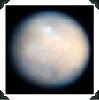
Still, by my personal definition, there would be many planets in our Solar System because not only would the traditional 9 planets be considered planets, but also Ceres (Image to right -- image from Wikipedia) -- which was considered a planet for half a century before reclassification as an asteroid (1800's) -- and a few other asteroids; and many of the larger satellites of Jupiter, Saturn, Uranus, and Neptune including Titan (Saturn) which has an atmosphere. There would also be the Trans-Neptunian celestial bodies which are similar to Pluto and also large enough to pull themselves into relative spheres.
We could always refer to the "Classical Planets" and the "Traditional Planets". The Classical Planets would be the planets visible with the naked eye excluding the Sun and Moon which were considered planets by the ancients and adding the Earth which I do not believe was considered a planet. The classical planets would be Mercury, Venus, Earth, Mars, Jupiter, and Saturn. The "Traditional Planets" would be those of the 20th century, or at least after the discovery of Pluto which would be the Traditional Nine Planets that most of us grew up with including Mercury, Venus, Earth, Mars, Jupiter, Saturn, Uranus, Neptune, and Pluto.

Then of course we have the IAU Planets -- Mercury, Venus, Earth, Mars, Jupiter, Saturn, Uranus, and Neptune.

I guess it would be silly to include the 19th & 20th Century list of planets -- Mercury, Venus, Earth, Mars, Ceres, Jupiter, Saturn, Uranus, Neptune, and Pluto -- but I had to just because I am me.

Perhaps being Canadian, I can understand not wanting to have to memorize the names of over two dozen planets -- after all I am comfortable with 10 provinces and now 3 territories. I know that my American cousins are a bit more familiar with knowing 50 states and their capitals as well as all the names of the presidents -- in order I have been told. I know that despite being a bit keen in the area of Astronomy as you might have noted if you read my column -- I do not know the names of all the major satellites of all the planets and once planets of the Solar System. I probably would have a good idea of which planet a given satellite orbited if you gave me its name... perhaps fumbling the ball a bit with Triton and Titan and Charon and Chiron -- the later an asteroid. Okay now I would know Titan is around Saturn and Triton... I would fairly certainly say orbited Neptune. Charon I would be good to go with Pluto... though I keep mixing the name up with Chiron... I might also mix up the Saturn and Jupiter families...

It would be worth trying... I have to try harder to remember the names of all my cousins too... of course now a lot of my cousins have children... But we aren't demoting any of them to acquaintances or strangers.

Later!
~ Darrell

107.

__________
* 2006 definition of a planet - Wikipedia.

** Dwarf planet - Wikipedia.

*** I am going to use the term Satellite rather than "Moon" because I think that the Earth has a natural Satellite named the "Moon" and other Planets have natural Satellites which each have their own names. It is a distinction I am making and I do not know that anyone else does.
.


DailyStrength - Free Online Support Groups

Sunday, July 20, 2008

Planets Planets Everywhere!

Planets Planets Everywhere - Are there some with water to drink?

There has been a search going on for extra-solar planets for a long time. It has been going on seriously for a couple of decades and there has been some success in finding them. Perhaps most people are not as familiar as I am with the fact that there has been success in finding these planets.

The planets found so far tend to be very large ones, many would dwarf Jupiter and many orbit their sun much closer than the planets of our own solar system. As of July 16, 2008 there are 307 candidates detected according to "The Extrasolar Planets Encyclopaedia" on their Catalogue Page. Of course that is "candidates" rather than saying "planets" as it is rather hard to prove completely without any possible doubt. That site I found not really for the casual reader but has a ton of very current information on it.

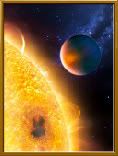
I find the Wikipedia Page on it -- "Extrasolar planet -- Wikipedia, the free encyclopedia" -- to be a much more interesting and digestible read. (image to right -- image from Wikipedia)

While most of the planets detected have been huge rating up to 13 times the mass of Jupiter which is the limiting mass beyond which a body is considered a Brown Dwarf Star rather than a planet in part this is because it is much easier to detect the much larger bodies using the only techniques we have. Also most of the planets we have detected are close to their suns and tend to be around smaller suns for similar reasons. A very large planet orbiting close to a small star is much easier to detect. The planet is larger in ratio to the sun and moves faster so the changes that are made are easier to observe.

We are detecting smaller bodies even so. From this we seem to be able to predict that the low mass planets may outnumber the Jupiter-like planets by a facter of 3 to 1.

Sometimes they seem to be a bit picky and arbitrary on things like definitions of what a planet is though... that is why Pluto is no longer considered a planet. According to the International Astronomical Union, the working definition for extrasolar planets established in 2001 and last modified in 2003 are:

1. Objects with true masses below the limiting mass for thermonuclear fusion of deuterium (currently calculated to be 13 Jupiter masses for objects of solar metallicity) that orbit stars or stellar remnants are "planets" (no matter how they formed). The minimum mass/size required for an extrasolar object to be considered a planet should be the same as that used in our Solar System.

2. Substellar objects with true masses above the limiting mass for thermonuclear fusion of deuterium are "brown dwarfs", no matter how they formed nor where they are located.

3. Free-floating objects in young star clusters with masses below the limiting mass for thermonuclear fusion of deuterium are not "planets", but are "sub-brown dwarfs" (or whatever name is most appropriate).

It seems that free-floating planetary-mass objects (planemo) or "rogue planets" or "interstellar planets" aren't included in the discussion on the Wikipedia page.

Personally I think it is very short sited to have a definition of "planet" that is dependant on orbital characteristics. I think that more important should be structure, size, and origin. In my definition, many of the larger moons would be included as planets. There would be ice planets and rock planets, There would also perhaps be a few varieties of gas planet and then there would be the "space junk" which in my definition would be masses which weren't large enough to form into a relative sphere. Thus a body like the earth which formed around another star, but which was thrown out of its orbit and captured by a gas giant or perhaps becomes free floating in interstellar space would still be a planet. But that is my personal view.

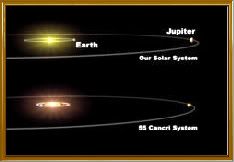
It does seem to me that if we can ever figure out some exotic interstellar propulsion system or other method of interstellar transport, there just might be reason to go to other stars. There seem to be other planets to look at and some might be like ours. System of 55 Cancri compared with our Solar System. (image to left -- image from Wikipedia)

Later!
~ Darrell

92.


DailyStrength - Free Online Support Groups

Friday, June 27, 2008

Benthic, I'm Sure

I Don't Think It's Pikachu?

They say that the surface area of either Mars or the Moon is greater than that of the Land-surface of the Earth. Whether it is Mars or the Moon is of little consequence here, but it points out something - the Earth is much bigger than the Moon or Mars in total surface area, but most of it is covered by the very thing we consider a prime requirement for life when we search for life out there in space.

The life we know most about clings to the skin of the surface of the world - even considering the tallest of trees or life creeping the deepest into caves or the earth. There is a vast amount of the earth that lays beneath the surface of the ocean even if we only consider the surface area. But consider this - the ocean is deep and creatures of the deep can live throughout the entire volume of the ocean, not just the top surface or the bottom.

Here is a quote from a collection of images from the dark depths of the oceans. The passage comes from "Animals in the depths of the sea (26 photo) / Biology / Science ReaDigg.COM":

On dry land, most organisms are confined to the surface, or at most to altitudes of a hundred meters—the height of the tallest trees. In the oceans, though, living space has both vertical and horizontal dimensions: with an average depth of 3800 meters, the oceans offer 99% of the space on Earth where life can develop. And the deep sea, which has been immersed in total darkness since the dawn of time, occupies 85% of ocean space, forming the planet’s largest habitat. Yet these depths abound with mystery. The deep sea is mostly uncharted—only about 5 percent of the seafloor has been mapped with any reasonable degree of detail—and we know very little about the creatures that call it home. Current estimates about the number of species yet to be found vary between ten and thirty million. The deep sea no longer has anything to prove; it is without doubt Earth’s largest reservoir of life.

It does make me wonder about the thin skin of life living on the surface of the Earth and what the total effect of rising oceans might be.

True changes might effect the deepest depths, but there is so very much variation of life in the depths that much might be survived even as it has in the past through total globe encompassing ice ages. (Not the less all inclusive ones most people know about which mankind survived and which todays shrinking glaciers are remnants of.) Of course that doesn't help mankind too much other than knowing life might survive in some form or another on the Earth even if we leave this mortal coil.

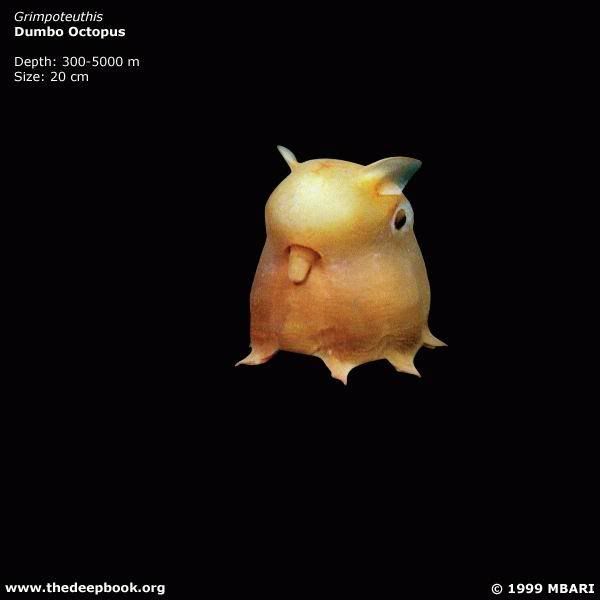
The life in this light-less world is pretty incredible and barely within our wildest dreams. Some seem to nearly mimic some dreams... or fiction in any case. Is it live or is it Pokemon? This one sure is reminiscent of Pikiachu. (image to right - image from Wikipedia) The critter in the picture to the left is a "Dumbo Octopus" - Grimpoteuthis (image to the left - image from science.readigg.com) and can be found in that collection of photos that the quotation above was from. There are a whole bunch of images on that site... they count 26 in their page title. I chose one of the cuter ones.

I do think we have to be better stewards of the environment and take care of our home, or our home might take care of us leaving others to come up from the depths to replenish the Earth. But I also think that with the weird and wonderful wildlife way below the waves we might have to really be careful on what we ascribe to habitable planets in our searches for life.

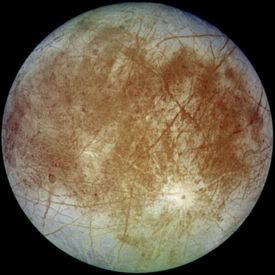
They say that at one time the earth - after life had developed already - had gone through an intense climatic change where there was runaway cooling and the whole of the surface of the earth was covered with a continuous sheet of ice. Yet, life survived in the oceans. The current theories are that Europa, (image to right - image from Wikipedia) the sixth moon of Jupiter, might have a water ocean beneath its icy crust kept liquid by tidal heating. Perhaps it is not unlike the ocean under the ice of that icy Earth of one time.

Of course life would have had to get its foothold and of course there would be less solar energy - though perhaps thermal and chemical energy might suffice... but it does leave room for thought and imagination.

Look at some of those undersea creatures of our own dark ocean environment and realize that even with our own technology we have hardly dabbled our toes into the depths. Look what we have seen so far and then use your imagination.

Later!
~ Darrell

70.

__________
Image of Moon used with permission from Image*After.


DailyStrength - Free Online Support Groups

Sunday, May 4, 2008

geology.com - Dig It

Dig It - More Than Dirt

There is a wealth of information on "Geology.com - Earth Science News, Maps, Dictionary, Artcles, Jobs". I wasn't sure what to expect from "geology.com" I have always been interested in geology and earth science with plate tectonics and continental drift; the stratigraphy of the Earth's crust; polished stones, crystals, and geodes; erosion; volcanoes; and mountain building - but I had forgotten about the celestial angle which comes into play as well with the geology of extraterrestrial bodies and even it seems galaxies in collision.

There are many gems on that page - and I mean gems of information and links to even more. There is a link to a page in geology.com on Galaxies in Collision which is a very visual article on galaxies colliding. I also like the article on Mapping Dark Matter in a Galaxy Supercluster. Again it is a very visual article - perhaps not everyone's cup of black coffee, but I know some of the physics-ly minded will appreciate it.

Putting our feet a bit firmer on terra firma, there is a link to a page with Igneous Rock Photos and there is an article on a special type of quartz crystal called a Herkimer Diamond which is a quartz crystal with a point on both ends named for Herkimer county, New York.

Perhaps you have to be a bit of a science fan like me to appreciate the page, but you might be surprised if you have a look.

Later!
~ Later

DailyStrength - Free Online Support Groups