Grandma & Grandpa's Farm
Showing posts with label change. Show all posts

Saturday, December 13, 2008

To Be Merry or not To Be Merry...

Happy Holidays!

Would you be offended if I wished you a "Merry Christmas"?

I know that many institutions worry that you might be -- or that it might lead to messy discussions about religion and perhaps politics.

To me holiday greetings like "Merry Christmas" are not attempts at evangelizing, but simply ways to share the joy I might be feeling at the time of an important holiday for me. I'm trying to share my joy. I don't mind if others share holiday greetings for other holidays that I might not celebrate. I don't celebrate Ramadan but would not be offended if someone were to wish me an enlightened one or if someone wished me Solstice Greetings.

I'm really not sure what an appropriate Ramadan greeting might be or if there is such a thing and I hope I do not offend in my not knowing. I'd like to know.

I think it is a good thing to be able to share our positive feelings with each other and perhaps a bit of our heritage and culture and especially to be able to hold onto our cultures. Celebrating Christmas just happens to be a part of my culture as blended as it might be..

Later!
~ Darrell

148.


DailyStrength - Free Online Support Groups

Friday, September 19, 2008

Grumpy Old Man -- Bush Administration: Sometimes they are more than just Shrubbery.

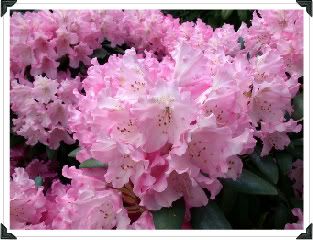
What does it mean when 40-year-old rhododendrons are butchered?

I am sure that many people will read a floral word like rhododendron and think "flower" and "decoration" but perhaps others will realize that they can grow to a large size and ripe old age. Rhododendrons¹ are broad leafed evergreen plants which bloom once a year in the Spring and can be simply covered with colour at that time. They are every bit as beautiful as blossoming cherry trees or apple trees. I think that many might think of them as the small shrubs they have in their flowerbeds and gardens, but they can grow to large sizes when they mature.

(image to left from Image*After)

I am not botanist nor horticulturist and my knowledge of plants -- whether flowering plants or trees -- is not vast, but I know a little and I appreciate heritage and beauty and the world that I live in. I also understand necessity -- but it doesn't stop my heart from breaking when I see something destroyed that might never be replaced and which provided beauty to a neighbourhood.

There were four mature rhododendrons thriving in front of our apartment building two days ago -- now there are none.

Yesterday I looked out my window and saw a small excavator working behind the building and wondered what was up. Were they going to replace some part of the retaining wall for the parking basement? Was there some landscaping need or were they going to improve the stairs leading from the back exit to the parking? Perhaps provide a walk from the front of the building to the back between our property and the house next door so people wouldn't be hopping fences and crossing between the buildings anyway.

(image to right from Image*After)

I became a bit concerned when they started putting up the modular construction fencing along the lane behind our building... this was serious. This was especially so when I noted they were going to put the fencing across the parking entrance to our building. That entrance is also the access to our building for anyone in a wheelchair or mobility scooter.² I went down and spoke to the fellows from the fence rental and they referred me to the contractor who I spoke with.

I found out from the contractor that they were going to be repairing or replacing the storm water drainage piping around the building and would have to be fencing off areas because they would have to be digging around the whole foundation and across the driveway. There is a narrow opportunity -- apparently -- because it has to be done after Summer and before the Fall and Winter rains.

Fair enough... some things have to be done and there are sometimes inconveniences that go along with them. I realized that likely there would be more excavators and even jackhammers and probably afterwards there would be the smells of paving for a while in the parking area that our balcony and windows overlook.

I nearly cried when I watched them carrying away the ruins of one of  the rhododendrons though.

(image to left of Rhododendron macrophylium from Wikipedia)

I am fairly certain they were a part of the building's original landscaping. This building, in its early days -- I believe in the early 1970's -- won awards for its landscaping and appearance. The rhododendrons stood 4.5 - 6 metres tall (15 - 16 feet) and must have been nearly 30 centimetres (1 foot) in diameter at the base of their trunks. There were two red flowering ones and two white flowering ones. The 4 bushes... trees? ...were wide enough that they spanned the width of the end of the building to either side of the entrance, framing it and helping to define the image of the building. Now the building looks naked.

(image to right from BelleWood-Gardens³)

I think with the rhodos the building looked as nice as any newer building, but without, it is just a box. The building was designed to have the landscaping -- it is plain to see -- as the stucco and siding only reach to within 10 feet of the ground leaving a broad band of bare concrete visible.

I have this sad feeling that the landscaping won't be replaced. Perhaps grass will be seeded rather than just letting the weeds move in and mowing them. But... the building just isn't being kept up by the current owners. It is no small wonder that they have problems finding good tenants for the building. But that is being cynical...

(image to left from BelleWood-Gardens³)

How does one replace 40-year-old rhododendrons? They bloomed on this street corner for over 35 years. They provided a visual accent to the building that made a big difference and the building really is one of the gateways to the residential district between the busy main street and the nature preserve on the hillside.

Losing them made my heart break even as necessary as it might have been to replace the building drainage... If it were my building, my investment, I would have seen about transplanting the trees somehow to be replaced back where they belong, or perhaps sell them and replace them with something equivalent. I know that the appearance of a building encourages pride in tenants and also draws decent ones when you need to find new ones.

How does one replace 40-year-old rhododendrons?

Later!
~ Darrell

138

__________
¹ Read about Rhododendrons at "Rhododendron Species Botanical Garden"

² I'll write about the accessibility aspects of all this in a later article.

³ "BelleWood-Gardens"  Garden Diary - May 2007; http://www.bellewood-gardens.com/05-2007.html


DailyStrength - Free Online Support Groups

Friday, September 12, 2008

A Different Perspective

Looking at Things From a New Angle

I think there has been a change in how many people look at things in the Western World. For much of the 20th Century -- up until the 1970's or 80's we were very much driven by paper. If we were doing a report or take notes we would write it on paper that was oriented vertically. Our TV's and movie screens however were oriented horizontally. The current terms used for these orientations -- at least in the world of the Internet, so far as I know -- are "Portrait" (image to left by DWP¹) and "Landscape" (image to right by DWP¹).

Where this comes important is when video digital terminals and later personal computer monitors came into common use. The terminals and monitors were nearly all in landscape orientation. There were a few notable exceptions I'll get to. This wasn't of great importance until people began to be able to compose documents on the computer or electronic word processor. The screen just didn't fit the printed word on paper. Paper of course normally in publication is in the portrait orientation.

To begin with there was little issue because people wrote on the computer and what they wrote was really not in the same format as what they expected to see printed on paper. Good "word processors" would have a tool for previewing what the printed document should look like and it was okay if this just took up a portion of the landscape oriented screen. Later word processing software and office suites -- to be joined with actual "Desktop Publishing" software -- actually was WYSIWYG (What You See Is What You Get). That meant that what you saw on the screen more and more resembled what was actually going to be seen on paper and at full size. Of course the screen went one way and the paper the other. For the most part that has just been accepted and programs have included modes that let you see shrunken versions that will fit on the monitor screen or just let you see a part of the page. Sometimes it is nice to see a two page or even multi-page preview on screen to see how things fit together as a whole document.

Apple did take a step forward with their Portrait Display for the Macintosh²³ (image to right - image from "myoldmac.net"). It was monochrome like the original Macs and since so were printers at the time, black print on white screen was just fine. (or many shades of grey) There also was pride on very white screens if I recall the term "paper white screen. There were also monitors developed that would rotate from landscape to portrait orientation. I think that the portrait oriented monitors were/are mostly used by people who do a lot of desktop publishing.

With the ability to have multiple monitors hooked up to computers now and shared desktops and so forth, there is a resurgence in use of portrait oriented monitors. (image to left - image from "MacNN Forumsª")  Probably the new thin designed screens also makes it easier to design and implement considering the lighter components inside without the hefty cathode ray tube (CRT) and transformers.

Note how the second portrait monitor fits so nicely to the left of the main, quite large monitor.

Consider this though: will there be a bias when people design pages, for them to design to the landscape page more often now than the portrait? I got to thinking about that a few years ago when designing event posters for the museum I volunteer at. (The Port Moody Station Museumº) I was designing the posters to fit on regular "letter" sized paper and thought about how we orient such stuff on the paper. Often maps will go landscape while small posters go portrait. When people put together websites although the screen tends to be landscape, the pages tend to either be designed to fit one page landscape or extend portrait style.

I was wondering if people seeing more and more things in text on a landscape screen would be tending to design documents on that landscape orientation? I know some things just fit better one way or the other. Many people do read things more easily in narrower columns so a wide page is a problem. (Sorry but I can't cite a source at the moment on that, it is something told me by teachers and I have read in articles on learning disorders. It has to do with the eye skipping up or down a line more easily on long lines.) But a wide page can take multiple columns like the news papers have.

Still I think people are more used to scrolling down a long web page than across one. Though the trackpad on my Macbook and the MightyMouse I bought for it can scroll horizontally with equal ease, most mice I have come across are intended to scroll vertically. I wonder though if younger people have less bias against horizontal scrolling and horizontally presented pages? Of course... do people have any bias at all in either direction? .

Later!
~ Darrell

134.

__________
¹ "DWP" -- That's me.

² "myoldmac.net -- Apple Macintosh Portrait Display -- Buy it!"

³ "Apple Portrait Display" MonitorWorld.com.

ª "The New Power Mac Picture Thread -- Page 13" blakespot; Sept 29, 2006, 6:00 pm: MacNN Forums

º "The Port Moody Station Museum Blog" 2734 Murray Street Port Moody, British Columbia, Canada (604) 939-1648 run by the Port Moody Heritage Society


DailyStrength - Free Online Support Groups

Monday, May 26, 2008

Life On a Fragile Planet

Life - Elsewhere?

From time to time I hear fairly educated people talking about the importance of space travel and one part of there argument goes that right now we have all of our eggs in one basket - the Earth - and if there were to be a global catastrophe human life would disappear from the universe. They go on to say that with global warming that catastrophe may be coming and that we could be looking at "terraforming" Mars or Venus for mankind to call homes and thus avert this possible catastrophe.

Maybe I have just read too much, but I see some flaws in this. The first and biggest one is that the "terraforming" of Mars or Venus is a project many orders of magnitude greater than actually controlling any problems of global warming that we might have created unintentionally or that might be happening naturally and that with the Earth we are starting with something a lot closer to what we want to end up with than where we would be starting with Mars or Venus. That being said, it only speaks to the issue of space exploration in order to escape from the damages caused by global warming. Meaning that if we can terraform Mars or Venus - then surely we can cure the problems of global warming on the Earth.

Granted at some time in the future, we might want to spread our wings and spread humankind into space in the Earth-Moon system and beyond. Mars is a obvious candidate for we could with our current technology probably figure out ways to survive there. Venus might take a bit more for it would be like trying to set up camp in hell. I think the atmospheric pressures on Venus are like that of being deep undersea and the temperatures enough to melt lead in an atmosphere with enough of a sulphuric acid content to etch any metal you might have in your kitchen.

It would be simpler to create some sort of space colony than to live on Venus probably. Of course that is compared with converting the whole planet into another Earth. There is also a concept where you start by covering an area with a kilometre high dome and creating your biosphere under it and then gradually in a modular fashion expanding the area covered until potentially the whole planet is covered. That is called Paraterraforming or the "worldhouse" concept. Perhaps not with Venus, but perhaps Mars or even the Moon.

It does lead to questions like do we want to do something like convert Luna into another Earth? No longer would we have that creamy white or silvery white orb shining down on us, but would have a much brighter white and blue one potentially. We lose something to gain something. We do that every time a city expands.

Cities - which are most often built in a location where the farming was best - expand and most often cover up the adjacet farmland. You lose farmland when you gain residential and commercial land.

That is a lot like that expansion of mankind to a "New Earth" on the Moon. We lose the Moon and gain a New Earth.

The near future Moon missions planned by a number of countries of the world might lead to permanent colonies on the Moon which might in turn lead to thoughts on Paraterraforming the Moon. How much change to the appearance of the Moon are we going to be expected to accept? Should the general "man on the street"* have any say in it?

What of other places? How about "Earth Orbit"? The International Space Station is very visible from the surface of the Earth and in fact you can find charts and tables telling you when and where you might spot it flying overhead. I'm not sure but an observant person with a good set of eyes or binoculars might be able to even spot it during the daytime?

Will there be a time when the sky might be visually "crowded" where there will always be a number of objects flinging across the night sky - not unlike being near a major international airport at night? I rather enjoy watching planes go by, but there might be a time when there will be no place on Earth that one might escape that aspect of civilization without benefit of a cave or very steep mountain valley.

I don't know if we'll ever build cities in space - large rotating colonies where people can live in a shirt-sleeve environment essentially as if they were on the Earth. If they are in Earth-orbit they will be very visible. I wonder how safe we would ever be able to make them?

I wonder if we will have colonies on the Moon, Mars, and other Terrestrial and Ice Bodies of the Solar System? Will we have interstellar space colonies - which are travelling off to other stars where it will only be the decedents of the people who start off who reach them, and who essentially in the meantime are dwellers of the space between the stars?

I think that before we have the technology to terraform other planets, that same technology would allow us to save the Earth from any sort of runaway ecological disaster. But in the meantime I know we have to take care of our fragile planet. It is the only one we have.

Later!
~ Darrell

44.

__________
* Yes I mean the gender neutral "man" and in "humans" or "mankind".
DailyStrength - Free Online Support Groups