Grandma & Grandpa's Farm
Showing posts with label Heritage. Show all posts

Tuesday, January 27, 2009

The Family Tableau

Family Life - Home Cooking

I wonder how many families have foods that are a bit unique to their family? I am thinking of foods that are quite possibly ethnic in origin that might not be so familiar to your friend's backgrounds. They are foods that might not seem unusual if you live in a community where your parents and grandparents -- uncles, aunts, cousins, and of course siblings -- grew up in. But if you no longer live in the lands of your parents... these dishes might be out of the ordinary.

(image to above right from Mennonite girls can cook)

For some of you there might be two completely separate sets of cuisine -- one from each parent's family -- or only one if your parents come from the same culture.

I come from in some ways three backgrounds. One is the fairly common generic Canadian-Average American one of bacon & eggs, pot roasts, fried chicken, macaroni & cheese, and that sort of thing. The other two are a bit more exotic though not Earth shattering.

Mom's parents originate from Norway and a few tastes have entered my culinary vocabulary from there -- though mostly it was diluted by way of New York and Alberta. There were a few things that basically only came out at Christmas time like Fattigman Bakkels or Cookies (image to left - image from about.com) which are deep fried and dusted with sugar. There also were cheeses and other foods that normally weren't bought or served except for during the holidays.

Dad came from a Mennonite community in Southern Manitoba that had come to North America around 1875 and hold cohesively as a community even today. There are many dishes I remember from our visits to family there which we have taken out here to the West Coast of Canada. Among many others is a favourite of my Sister's and mine, "Wareneki" or "Vareneki" -- in particular "Blueberry Wareneki".

Wareneki are one of those foods that sort of turn up all over the place in one version or another. I find they are different from perogis though some consider them the same. I think some would consider them a stuffed noodle or liken them to ravioli I guess. Anyhow the translation of wareneki I have seen is "fruit pocket" though I wonder if simply "pocket" or "dough pocket" might be more true?

Basically you make a dough and roll it out, then you cut out circles and put the fruit in the centre with a bit of sugar and press the edges together. You carefully put the sealed pockets into boiling water to cook and then serve with a cream sauce. Now my Grandma and relatives tend to make squares and fold the corners in so that the points meet in the center giving a squarish wareneki rather than the more crescent shaped ones shown in the pictures I am including, but I am sure they taste the same... I think the more square ones might hold a bit more of the sweet fruit filling.

(image to above right from Mennonite girls can cook)

Now the two pictures from "Mennonite girls can cook" show cottage cheese wareneki or "Glums Wareneki" rather than the blueberry wareneki, but they are fairy illustrative. Some people also make saurkraut wareneki, but I think they are spoil sports. I guess I grew up with the treat of blueberry wareneki from freshly picked blueberries while other folk might remember other fruits more.

(images above to left and right from recipezaar.com)

To me though blueberry wareneki were like eating dessert for dinner!

Technorati Tags: , , , , ,

Later!
~ Darrell

(I have also posted this on my Xanga site.)

155.


DailyStrength - Free Online Support Groups


Tuesday, November 11, 2008

For Remembrance Day -- 11 11 2008

Poppy

Uniform Memory


When I was young,
I wore a uniform
Not a soldier proud
Going off to war
For King
For Country
Probably for
Adventure
To get off of the Farm
Or out of the Factory Plant
Or Dark Coal Mine.

But before it was over
Seeing friends new
Friends old
Strangers once
Become Brothers
Blown to bits
Shot to meat
Once vital
Now dead.

When I was young,
The uniform I wore
Was not of a soldier
For I was lucky
Luckier than most
For my years of youth
Mine were spent in peace
Peace perhaps relative
Peace perhaps born
On the shoulders of others.

But others
They paid horrible price
Perhaps
Not even truly knowing why
Just knowing it was needed
Not asking why
Just doing
Just dying
Just or unjust.

When I was young,
Yes, I was only a Cub
But somehow I could feel
Somehow I felt a connection
Somehow I could feel the loss
The loss of the missing
Perhaps the loss of others
Of others' fathers
Of others' grandfathers
Husbands, brothers, sons

But though not directly touched
Somehow I knew
Somehow I felt
Pride
Pain
Love
A minute of silence
That echoed in my heart
As strongly as if
The war was only yesterday
Not decades before

Now they are young,
Fresh faces wondering
At the few old wrinkled faces
The berets
The ribbons
The medals
The statues
The wreathes
The poppies
A tear
A moment of silence
One.one,  one.one,  one.one

But do they connect
Do they feel the loss
Does it make sense
Do they remember
Do they find it only
One more oddly named
Long weekend
In the so long school year
Is it  so sad

Now is it so sad
That these young
Are not so close
To the wars once remembered
Are these not those
That were fought for
That truly they would not
Need to know war  as the others before?

But it is sad.
For war has not left
More children must learn
More people must leave
Family
Friends
Freedom
To fight
For freedom
For feuds
For feudalism
For fuel

Now as it was it is in the end
They fight in the end
They fight for their life
They fight and see a friend
Blown up
Shot up
Burned up
Burned out
They fight bravely and for cause
They fight without question
For that the brave sometimes must do
They do it for themselves
But they also do it for you.

But it is sad
Another generation must morn
Lost soldiers
Not just Father,
Grandfather
Brother, Son
Uncle
But now also Mother
Grandmother
Sister, Daughter
Aunt, and Friend
Though truth be told
It has always been so
Just not always so much
In uniform

One day perhaps
It will only be
War remembered in memory
Fading, but not forgotten
Perhaps a scar but not a wound
And the children
Might wonder,

At the few old wrinkled faces
The berets
The ribbons
The medals
The statues
The wreathes
The poppies
A tear
A moment of silence
One.one,  one.one,  one.one

Darrell Wade Penner November 4th 2003


Friday, September 19, 2008

Grumpy Old Man -- Bush Administration: Sometimes they are more than just Shrubbery.

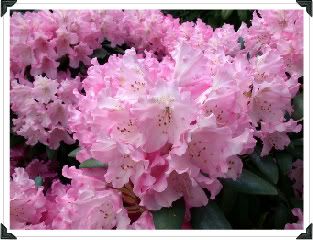
What does it mean when 40-year-old rhododendrons are butchered?

I am sure that many people will read a floral word like rhododendron and think "flower" and "decoration" but perhaps others will realize that they can grow to a large size and ripe old age. Rhododendrons¹ are broad leafed evergreen plants which bloom once a year in the Spring and can be simply covered with colour at that time. They are every bit as beautiful as blossoming cherry trees or apple trees. I think that many might think of them as the small shrubs they have in their flowerbeds and gardens, but they can grow to large sizes when they mature.

(image to left from Image*After)

I am not botanist nor horticulturist and my knowledge of plants -- whether flowering plants or trees -- is not vast, but I know a little and I appreciate heritage and beauty and the world that I live in. I also understand necessity -- but it doesn't stop my heart from breaking when I see something destroyed that might never be replaced and which provided beauty to a neighbourhood.

There were four mature rhododendrons thriving in front of our apartment building two days ago -- now there are none.

Yesterday I looked out my window and saw a small excavator working behind the building and wondered what was up. Were they going to replace some part of the retaining wall for the parking basement? Was there some landscaping need or were they going to improve the stairs leading from the back exit to the parking? Perhaps provide a walk from the front of the building to the back between our property and the house next door so people wouldn't be hopping fences and crossing between the buildings anyway.

(image to right from Image*After)

I became a bit concerned when they started putting up the modular construction fencing along the lane behind our building... this was serious. This was especially so when I noted they were going to put the fencing across the parking entrance to our building. That entrance is also the access to our building for anyone in a wheelchair or mobility scooter.² I went down and spoke to the fellows from the fence rental and they referred me to the contractor who I spoke with.

I found out from the contractor that they were going to be repairing or replacing the storm water drainage piping around the building and would have to be fencing off areas because they would have to be digging around the whole foundation and across the driveway. There is a narrow opportunity -- apparently -- because it has to be done after Summer and before the Fall and Winter rains.

Fair enough... some things have to be done and there are sometimes inconveniences that go along with them. I realized that likely there would be more excavators and even jackhammers and probably afterwards there would be the smells of paving for a while in the parking area that our balcony and windows overlook.

I nearly cried when I watched them carrying away the ruins of one of  the rhododendrons though.

(image to left of Rhododendron macrophylium from Wikipedia)

I am fairly certain they were a part of the building's original landscaping. This building, in its early days -- I believe in the early 1970's -- won awards for its landscaping and appearance. The rhododendrons stood 4.5 - 6 metres tall (15 - 16 feet) and must have been nearly 30 centimetres (1 foot) in diameter at the base of their trunks. There were two red flowering ones and two white flowering ones. The 4 bushes... trees? ...were wide enough that they spanned the width of the end of the building to either side of the entrance, framing it and helping to define the image of the building. Now the building looks naked.

(image to right from BelleWood-Gardens³)

I think with the rhodos the building looked as nice as any newer building, but without, it is just a box. The building was designed to have the landscaping -- it is plain to see -- as the stucco and siding only reach to within 10 feet of the ground leaving a broad band of bare concrete visible.

I have this sad feeling that the landscaping won't be replaced. Perhaps grass will be seeded rather than just letting the weeds move in and mowing them. But... the building just isn't being kept up by the current owners. It is no small wonder that they have problems finding good tenants for the building. But that is being cynical...

(image to left from BelleWood-Gardens³)

How does one replace 40-year-old rhododendrons? They bloomed on this street corner for over 35 years. They provided a visual accent to the building that made a big difference and the building really is one of the gateways to the residential district between the busy main street and the nature preserve on the hillside.

Losing them made my heart break even as necessary as it might have been to replace the building drainage... If it were my building, my investment, I would have seen about transplanting the trees somehow to be replaced back where they belong, or perhaps sell them and replace them with something equivalent. I know that the appearance of a building encourages pride in tenants and also draws decent ones when you need to find new ones.

How does one replace 40-year-old rhododendrons?

Later!
~ Darrell

138

__________
¹ Read about Rhododendrons at "Rhododendron Species Botanical Garden"

² I'll write about the accessibility aspects of all this in a later article.

³ "BelleWood-Gardens"  Garden Diary - May 2007; http://www.bellewood-gardens.com/05-2007.html


DailyStrength - Free Online Support Groups

Tuesday, September 16, 2008

May I Have This Post?

Is Your Post Card Filled?

Value and Romance on a Small Bit of Paper

You see them around all over the place, now mostly in tourist travelled trading places, guest shops, souvenir shops, and landmarks and you might have heard people telling you to send in a card with your name, address and current phone number to various places. (image to right -- image from Image*After¹) Of course you have seen the business reply cards in magazines and as warranty registration cards. Of course I am talking about postcards -- something that has been with us for over a century now. They officially came into being in 1861 -- developed by John P. Charlton from Philadelphia who transferred his copyright to H.L. Lipman -- "Lipman's Postal Card, Patent Applied For". Governments took over, including exclusive right to call them "Postcards" in 1893.

What is the value of a postcard? They are a very simple way to send a message by post for one thing and often they can be sent at a lower price than a regular letter. Today the cost to mail one is not too much different from a letter and of course anyone can read what is written on them. My Mom used to say that the person on vacation sending you a postcard -- or post card -- most often already had returned home by the time it reaches its recipient because each person in the post office who handles it take a moment to read it.

(images above from A Brief History of Post Cards²)

I imagine there are no secrets in a post card... unless you put it into an envelope or parcel or deliver it by hand.

But postcards have something special to them, mailed or not. In picking out a postcard to send someone, you are in a foreign location perhaps, maybe on vacation, maybe on business, but taking a few moments out of your day to think of others. I am getting away from the business sorts, like business reply mail and warranty cards here. They also are something from that place although it is possible to order postcards of exotic locations from the comfort of your home. A person might take their own photographs and write something on the back of them as mementos to send or keep, but still there is an interesting feeling with postcards.

Postcards historically are of values in that they capture a bit of a time and place and sometimes sentiment and feeling of that time. They trace the progress of a community with their snapshots of buildings and roads. Even showing one thing they often show others. A shot of a building might also show cars and people in it and give a glimpse at how they lived. If you look at a postcard from two different periods you might see how telegraph wires were added to be replaced by telephone wires to be replaced by underground wiring.

Postcards could be "wishes" of places a person wanted to visit or things they wanted to purchase or they might be telling of where they finally got or what they got. Businesses have often created PR with postcards and often very artistic ones.

You can find Canada's official Postcard Barrel at the Port Moody Station Museum. Deposit or pick up unstamped postcards during Museum open hours for hand delivery around the world.

Some subjects of postcards: Distant places, Architecture, Vacation Destinations, Advertisements, Street Scenes, Artwork, Landmarks, Cities, Towns, Wars, Heroes, Events,  Politics, Celebrities, and probably other subjects.

Our museum -- The Port Moody Station Museum³ (image to right) -- has a "Postcard Barrel" which is Canada's Official Postcard Barrel! I know there is one on the Galapagos Islands as well. They are an odd sort of thing, you drop a post card into it that you want sent somewhere in the world and people visiting have a look through and pick out ones close to where they are going and hand-deliver them. (see inset left)

You can always send an email, or take a picture to share, or buy postcards to take with you and give to friends -- but to mail it from afar, where it takes on a postal cancellation stamp, and perhaps a local stamp as well, and travel through the postal system until it reaches a friend's home and hand -- that ads something special and romantic to the whole thing. It is a bit more than a photo or a letter. It is a special souvenir not only of a place, but a time and a person.

Later!
~ Darrell

136.

__________
¹ Image*After Unattributed images from Image*After.

² "A Brief History of Postcard Types" Stefano Neis - Yahoo! GeoCities/Heartland/Meadows.

³ "The Port Moody Station Museum" 2734 Murray Street, Port Moody, BC

"Why Use A Postcard" Anders Eriksson - Post Cards usinfo.info

"History of Postcards" Emotions Greeting Cards.


DailyStrength - Free Online Support Groups

Friday, May 30, 2008

Tower Bridge - Art or Recording

Real or Realistic?

This Photo by Giorgos is from his collection on flickr and shows some of his excellent work. The question is - can an image either created completely by an artist of a scene or an adjusted photo or video of a scene be better than the actual unaltered photo when it comes to usefulness to people trying to appreciate the scene?

For instance from a heritage point of view. Is an adjusted photo of the Tower Bridge better than a photo? This is in a sense "hyper-reality" in that it really emphasizes the features of the architecture that might not be visible or as appreciated in the sort of photo that might be now take given particulate matter and pollution.

I think there are many times that emphasized images can be of use and that most photos are tinkered with in some manner since we must chose things like depth of field and exposure as well as focus and lighting to begin with. I do think that it is important to try and keep unaltered images as well as the altered ones though. You wouldn't want to add features that were never there an in fact it probably is useful to actually keep using film cameras for the same reason they try to leave some parts of archaeological sites untouched. In future there may be better ways to glean information from the negatives than we now have.

Digital images only have what bits there are. That is their strength and weakness.

I am experimenting by posting this from flickr's "blog this image" feature so that I can include an image in the post. Otherwise it might be awkward copyright-wise. I think I am in the clear doing it this way. I might have to come back to clean things up to make the post fit a bit better into the Stump.

Later!
~ Darrell

47


DailyStrength - Free Online Support Groups

Monday, May 5, 2008

City of Tomorrow

Living in the City of Tomorrow

Can you live in the "City of Tomorrow"?

I might ask this a few times in coming blog columns or articles or whatever you would call these. But today I think I will be focusing on living space and how you will be getting places to do the things you do every day.

Where will you be living in the city of tomorrow... well I can't speak for everyone so I will talk about many of the average people out there who will be either renting or buying lower priced living spaces. I am also going to use the City of Port Moody where I live here in British Columbia as an example. Your mileage may vary.

Here they are looking strongly at "densification" and doing so in ways that are controlled and in the ways that won't detract from living here. Densification means increasing the number of people living in an area without increasing the amount of area they take up.

Here it means a number of things based on what is important to the people. For one thing Heritage is important to the people of Port Moody so they wish to preserve the heritage features of Port Moody Centre. Port Moody Centre encompasses much of the original settlement of Port Moody from the time when the first Canadian Trans Continental Railway was completed with Port Moody being the Western Terminus. That means there are residential neighbourhoods and commercial neighbourhoods that are to be considered in the "Heritage Zone" to be protected in some manner.

There is also a residential development spreading up Eagle Mountain to the North called "Heritage Mountain" and "Newport Village" at the head of Burrard Inlet where the Civic Centre and a major density core has been developed. In addition there is "College Park" at the foot of Burnaby Mountain where Simon Fraser University is and "Ioco" another heritage site across the inlet.

Areas between the Civic Centre & Newport Village and Port Moody Centre's Heritage Zone will be filled with a combination of residential and retail construction. At the Civic Centre area in the east there will be a mix of High-rise and Mid-rise apartment buildings with commercial property and parking beneath them. Spreading westward along the south edge of the inlet and north of the railroad tracks, which were a major part of Port Moody's early growth, will be 3 - 5 story low-rise apartment buildings with commercial property at ground level. This follows the main arterial through the city. This continues with some older residential property to the south running up to a nature preserve running along the escarpment which marks the south edge of the city rising up to the city of Coquitlam. This older residential neighbourhood has some heritage quaility, but is not in the preserved zone it is contiguous with it though blending into to it to the west.

There we run into the Heritage Zone proper and many older homes on the heritage register. Between there and the railroad tracks are the commercial heritage buildings marking the original commercial centre of Port Moody. A bit further west and we reach the hillside running up first to College Park and then up Burnaby Mountain proper.

That gives a bit of background...

There will be some continued development up Eagle Mountain, but they don't want to just plough down the 100 - 300 foot tall Douglas Fir and Red Cedar growing on the mountain and ruining the natural ecology. The Heritage mountain development for the most part is single family dwellings. Newport Village is a combination of high-rises and mid-rises as mentioned and blends into more like I said reaching towards where a proposed rapid transit station is to be. The areas of single family dwellings off Heritage Mountain neighbourhood will be increased in density by allowing for secondary suites and for "Carriage Houses" in the yards off the lanes. Carriage Houses are garages and similar buildings built with secondary suites on a second floor or sometimes on the main floor too forgoing the garage aspect. It doubles the density of the property without sprawling it to additional property.

There will be incentive too for people subdividing larger property, but keeping in mind for some neighbourhoods that it is the very spacing of houses and trees between them that gives the feel to the neighbourhood.

So where will people be living? Many will still live in single family dwellings that they own. A much larger percentage will live in strata property like low, mid, and high-rise buildings - that is owning a part of that property like a condo or townhouse even. Some of those units will be put up for rent of course where allowed. But there also still will be rental apartments as well as those secondary suites in houses and carriage houses.

So for many they will get up in the morning in their cozy condo take an elevator down to the lobby and walk a few blocks to a transit station where they will travel by automated light rail transit to a location either near their work or a short bus ride from it.

Others will leave their home on the mountain and grab a community shuttle down to the transit station where they will meet up with the other travellers and continue on their journey.

There will be still others who will take there car in to work. Hopefully it will be fewer than has been and the improvements to the roads will help reduce travel times and thus reduce their fuel consumption in the ever more fue frugal vehicles.

I have heard that the suites in the high-rises are rather tiny compared to single family dwellings or even your typical townhouse. There is a price for living in the sky. My parent's townhouse is huge! It is quite functional, though perhaps larger than what they need right now.

I am not sure if the mid and low-rise buildings are the same for suite size?

I have been in a nice coach house in nearby Vancouver... of course this was a real coach house and you could still see the fittings for the posts that were used to tie the horses to. But it was a very nice sized cozy one-bedroom home. in the back of a Victorian house. I guess a hundred years ago most people at a certain level of affluence had their own horses and carriage. I guess I am meaning a bit over a hundred years, like pre-1905.

A friend of mine had a large property in what was to become the heritage area. He renovated a heritage house and converted it to suites to rent. He then built a garage with a 2 bedroom suite above and actually two commercial shops on the main level. Even as he was completing the commercial shops, he purchased and moved another one story heritage house from another lot - the house was slated to be destroyed so the now commercial property could be developed - onto that lot he was developing. He put in a new basement with a commercial space and rented the house as commercial property.

The city was happy to have two heritage buildings renovated - one saved from demolition - and four commercial properties added in addition. the property was underused and still has the great trees on it that were there from the beginning and a nice yard and room for lawns and gardens. My friend gets the revenue from the suites in the house and "barn" as wel as the commercial properties. It doesn't change the nature of the neighbourhood either as the property is on the edge of the commercial and residential area of the now Heritage zone.

People in the Heritage Zone will be for a large part within walking distance of a rapid transit station as well or on a short ride from a community shuttle to one.

For schooling, they are encouraging walking pools where a parent supervises groups of children walking to school rather than each parent driving their kid the short distance. (I still don't understand how kids can no longer walk to school?)

The commercial properties I kept mentioning on the lower floors of the buildings will have many functions including things like grocery stores. That means that people will be able to get many things they need by simply taking the elevator down and walking a block or two if that.

But... can you live without sitting in your car for between one and three hours a day? Now of course simply swapping sitting in a car for sitting in a train or bus is hardly so much of a bargain... But if you can get a chance to work in a commercial property within 15 minutes of home by public transit or walking? ... !

I think I might have too much to say and perhaps have tried to say too much here. I might try to speak a bit more directly to different points on this subject in future. For instance there are many who ar enot happy about the automated light rail transit coming through town.

Later!
~ Darrell

DailyStrength - Free Online Support Groups