Grandma & Grandpa's Farm
Showing posts with label biology. Show all posts

Thursday, October 2, 2008

Running Bear in the Subway!

Bear Learns Fast Food is Deadly

I didn't want to get too humorous in my titles here because the reason I am writing it was that it made me very sad.

(image to left from Kitimat Sentinel

A "Subway®" restaurant -- sandwich shop-deli -- worker, Rebecca Branton¹, was surprised last Monday morning, Sept 15,2008, at 6:15 am² by a black bear in the restaurant. There is a video of the whole incident hosted by CBC which took place in Kitimat, BC.

The CBC News report of the incident is on YouTube.

The employee was in back when the bear entered the restaurant and she spotted movement on the security camera.³

CBC News:¹

"I was just back there making soup ...but I saw the door open and it was a bear,"

(image to right from CBC News

Branton had the frame of mind to hurry to the washroom with her cellphone and lock herself in and phone for help, calling her parents. She had thought the bear might have used the handicap button to enter -- she had heard the buzzer for the door go off, but saw nothing in the morning dark.

Northern Sentinel:²

“I kept watching the door and then all of a sudden a bear came in and I was like ‘oh my god’.”

She explained, “It stood up on its hind legs and pulled the door open like a person and got down on all fours and the door closed behind it as it walked in.”

(Image to left from CBC news

Branton called her mom first not being sure what to do, but called the police afterwards.² The police arrived quickly and her parents also came down. The 10 minutes or so were terrifying and she felt isolated in the washroom as she heard the bear moving about in the shop. The bear sniffed around and at one point hopped on the counter.

It didn't apparently eat anything before jumping back down and eventually made its way out of the Subway® restaurant. Conservation Officers also arrived and set up a watch at the Dairy Queen® lot -- where the bear had come through to get to the Subway®

(image to right from The Guardian)

Sadly this curious young bear -- approximately two-years-old -- was later put down by Conservation officers in the downtown area of Kitmat. They felt there was a danger that this bear would continue to return to the area and coming back being a danger to the public. Some might wonder why they didn't tranquilize the bear. I wondered it, but then considered... in the area around Kitimat, with all the wilderness, black bears might not be considered that special -- sadly.

(image on left from Subway® Restaurants International)

I feel sad for this intelligent creature who was so curious and intelligent. In the video he reminds me somewhat of a curious house cat or dog looking around where he might be caught doing something naughty. There was something to the curiosity and intelligence which struck a chord with me when I heard the handsome creature was destroyed. It often ends poorly for the animal when wildlife and humans interact.

Later!
~ Darrell

143

¹ "B.C. black bear pops in for fast food" CBC News, Oct 1, 2008; CBC.ca.

² "Hairy start to Subway worker's day" Kitimat Sentinel, Published Sept 24, 2008 (Web Page dated: Oct 1, 2008); NorthernSentinel.com.

³ CBC News reports the incident happening last Thursday (Sept 25) while the video shows "2008 09 15". The Northern Sentinel article reports it being "Monday" and considering the article was published September 24 puts credence to the Monday September 15 date for the incident.

"Black bear checks out sandwich shop" Oct 1, 2008 Charolottetown, The Guardian


DailyStrength - Free Online Support Groups

Friday, September 19, 2008

Grumpy Old Man -- Bush Administration: Sometimes they are more than just Shrubbery.

What does it mean when 40-year-old rhododendrons are butchered?
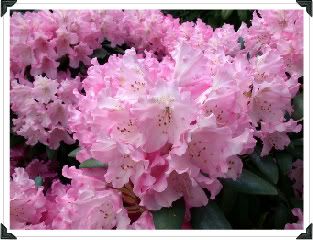
I am sure that many people will read a floral word like rhododendron and think "flower" and "decoration" but perhaps others will realize that they can grow to a large size and ripe old age. Rhododendrons¹ are broad leafed evergreen plants which bloom once a year in the Spring and can be simply covered with colour at that time. They are every bit as beautiful as blossoming cherry trees or apple trees. I think that many might think of them as the small shrubs they have in their flowerbeds and gardens, but they can grow to large sizes when they mature.

(image to left from Image*After)

I am not botanist nor horticulturist and my knowledge of plants -- whether flowering plants or trees -- is not vast, but I know a little and I appreciate heritage and beauty and the world that I live in. I also understand necessity -- but it doesn't stop my heart from breaking when I see something destroyed that might never be replaced and which provided beauty to a neighbourhood.

There were four mature rhododendrons thriving in front of our apartment building two days ago -- now there are none.

Yesterday I looked out my window and saw a small excavator working behind the building and wondered what was up. Were they going to replace some part of the retaining wall for the parking basement? Was there some landscaping need or were they going to improve the stairs leading from the back exit to the parking? Perhaps provide a walk from the front of the building to the back between our property and the house next door so people wouldn't be hopping fences and crossing between the buildings anyway.

(image to right from Image*After)

I became a bit concerned when they started putting up the modular construction fencing along the lane behind our building... this was serious. This was especially so when I noted they were going to put the fencing across the parking entrance to our building. That entrance is also the access to our building for anyone in a wheelchair or mobility scooter.² I went down and spoke to the fellows from the fence rental and they referred me to the contractor who I spoke with.

I found out from the contractor that they were going to be repairing or replacing the storm water drainage piping around the building and would have to be fencing off areas because they would have to be digging around the whole foundation and across the driveway. There is a narrow opportunity -- apparently -- because it has to be done after Summer and before the Fall and Winter rains.

Fair enough... some things have to be done and there are sometimes inconveniences that go along with them. I realized that likely there would be more excavators and even jackhammers and probably afterwards there would be the smells of paving for a while in the parking area that our balcony and windows overlook.

I nearly cried when I watched them carrying away the ruins of one of  the rhododendrons though.

(image to left of Rhododendron macrophylium from Wikipedia)

I am fairly certain they were a part of the building's original landscaping. This building, in its early days -- I believe in the early 1970's -- won awards for its landscaping and appearance. The rhododendrons stood 4.5 - 6 metres tall (15 - 16 feet) and must have been nearly 30 centimetres (1 foot) in diameter at the base of their trunks. There were two red flowering ones and two white flowering ones. The 4 bushes... trees? ...were wide enough that they spanned the width of the end of the building to either side of the entrance, framing it and helping to define the image of the building. Now the building looks naked.

(image to right from BelleWood-Gardens³)

I think with the rhodos the building looked as nice as any newer building, but without, it is just a box. The building was designed to have the landscaping -- it is plain to see -- as the stucco and siding only reach to within 10 feet of the ground leaving a broad band of bare concrete visible.

I have this sad feeling that the landscaping won't be replaced. Perhaps grass will be seeded rather than just letting the weeds move in and mowing them. But... the building just isn't being kept up by the current owners. It is no small wonder that they have problems finding good tenants for the building. But that is being cynical...

(image to left from BelleWood-Gardens³)

How does one replace 40-year-old rhododendrons? They bloomed on this street corner for over 35 years. They provided a visual accent to the building that made a big difference and the building really is one of the gateways to the residential district between the busy main street and the nature preserve on the hillside.

Losing them made my heart break even as necessary as it might have been to replace the building drainage... If it were my building, my investment, I would have seen about transplanting the trees somehow to be replaced back where they belong, or perhaps sell them and replace them with something equivalent. I know that the appearance of a building encourages pride in tenants and also draws decent ones when you need to find new ones.

How does one replace 40-year-old rhododendrons?

Later!
~ Darrell

138

__________
¹ Read about Rhododendrons at "Rhododendron Species Botanical Garden"

² I'll write about the accessibility aspects of all this in a later article.

³ "BelleWood-Gardens"  Garden Diary - May 2007; http://www.bellewood-gardens.com/05-2007.html


DailyStrength - Free Online Support Groups

Tuesday, August 19, 2008

Walk the Walk -- A Dolphin Tail

Culture in Dolphins

It seems that like Humans and Apes; Dolphins share culture among themselves. Near Adelaide on the south coast of Australia is a group of dolphins is learning to "tail-walk". (image to right -- image from BBC NEWS) Tail-walking is not a typical behaviour found in dolphins in the wild but is one taught to them in captivity. A female dolphin in that group, Billie, had spent a short time in a dolphinarium 20 years ago¹.

Twenty years ago Billie had been trapped in a marina lock and was suffering from malnutrition and sickness so they put her in a local dolphinarium for a few weeks in the 1980's. She was never trained while their, but apparently she had seen other dolphins at the dolphinarium tail-walking. It is inferred that with other females in her group having picked up the behaviour of tail-walking that they have learned it from Billie.

Mike Bossley-Whale and Dolphin Conservation Society²

"It would seem that among the Port River dolphins we may have an incipient tail-walking culture."

Sharing cultural behaviour is something that is known in apes and it has been documented that dolphins off Western Australia are known to use sponges as an aid in gathering food and to teach their young how to use them². Tail-walking would be considered a "cultural behaviour"² like language which helps define a group. "we may have an incipient tail-walking culture."²

I know that many species of whales, dolphins, and their kin have differences in "language" between different populations that are different enough that the part of the world an individual is from can be told by the dialect/accent of their speech-song-voice even while they are physically the same species and I believe it has been shown that this is learned behaviour

It is interesting that a skill that probably was learned by one individual in a few weeks by observation by one dolphin has now been mastered and is being taught in her family group. I think it is very interesting how many things we think of as definingly "human" is within the scope of some animal we have studied. Of course dolphins are very intelligent creatures that are very social.

I even recall seeing that sometimes dolphins and whales might even cooperate with feeding... We should try be more like dolphins.

Later!
~ Darrell

120.

__________
¹ "Wild dolphins tail-walk on water" Richard Black 19 August 2008, BBC NEWS | Science/Nature.

² Dr Mike Bossley, Whale and Dolphin Conservation Society, scientist monitoring the group on the Port River estuary.


DailyStrength - Free Online Support Groups

Friday, June 27, 2008

Benthic, I'm Sure

I Don't Think It's Pikachu?

They say that the surface area of either Mars or the Moon is greater than that of the Land-surface of the Earth. Whether it is Mars or the Moon is of little consequence here, but it points out something - the Earth is much bigger than the Moon or Mars in total surface area, but most of it is covered by the very thing we consider a prime requirement for life when we search for life out there in space.

The life we know most about clings to the skin of the surface of the world - even considering the tallest of trees or life creeping the deepest into caves or the earth. There is a vast amount of the earth that lays beneath the surface of the ocean even if we only consider the surface area. But consider this - the ocean is deep and creatures of the deep can live throughout the entire volume of the ocean, not just the top surface or the bottom.

Here is a quote from a collection of images from the dark depths of the oceans. The passage comes from "Animals in the depths of the sea (26 photo) / Biology / Science ReaDigg.COM":

On dry land, most organisms are confined to the surface, or at most to altitudes of a hundred meters—the height of the tallest trees. In the oceans, though, living space has both vertical and horizontal dimensions: with an average depth of 3800 meters, the oceans offer 99% of the space on Earth where life can develop. And the deep sea, which has been immersed in total darkness since the dawn of time, occupies 85% of ocean space, forming the planet’s largest habitat. Yet these depths abound with mystery. The deep sea is mostly uncharted—only about 5 percent of the seafloor has been mapped with any reasonable degree of detail—and we know very little about the creatures that call it home. Current estimates about the number of species yet to be found vary between ten and thirty million. The deep sea no longer has anything to prove; it is without doubt Earth’s largest reservoir of life.

It does make me wonder about the thin skin of life living on the surface of the Earth and what the total effect of rising oceans might be.

True changes might effect the deepest depths, but there is so very much variation of life in the depths that much might be survived even as it has in the past through total globe encompassing ice ages. (Not the less all inclusive ones most people know about which mankind survived and which todays shrinking glaciers are remnants of.) Of course that doesn't help mankind too much other than knowing life might survive in some form or another on the Earth even if we leave this mortal coil.

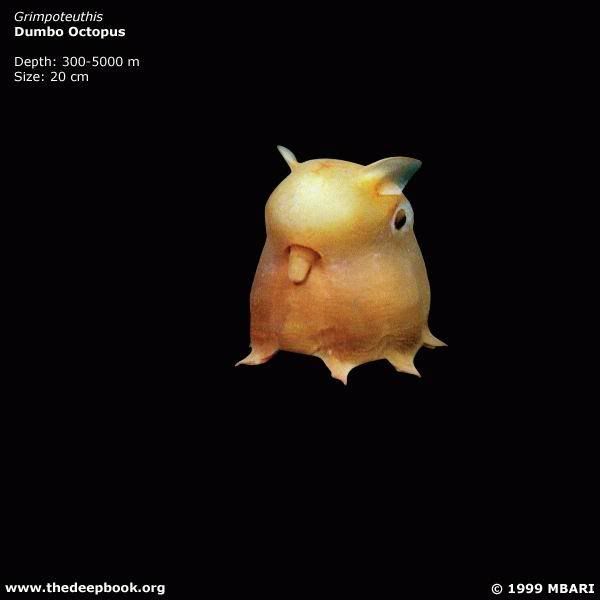
The life in this light-less world is pretty incredible and barely within our wildest dreams. Some seem to nearly mimic some dreams... or fiction in any case. Is it live or is it Pokemon? This one sure is reminiscent of Pikiachu. (image to right - image from Wikipedia) The critter in the picture to the left is a "Dumbo Octopus" - Grimpoteuthis (image to the left - image from science.readigg.com) and can be found in that collection of photos that the quotation above was from. There are a whole bunch of images on that site... they count 26 in their page title. I chose one of the cuter ones.

I do think we have to be better stewards of the environment and take care of our home, or our home might take care of us leaving others to come up from the depths to replenish the Earth. But I also think that with the weird and wonderful wildlife way below the waves we might have to really be careful on what we ascribe to habitable planets in our searches for life.

They say that at one time the earth - after life had developed already - had gone through an intense climatic change where there was runaway cooling and the whole of the surface of the earth was covered with a continuous sheet of ice. Yet, life survived in the oceans. The current theories are that Europa, (image to right - image from Wikipedia) the sixth moon of Jupiter, might have a water ocean beneath its icy crust kept liquid by tidal heating. Perhaps it is not unlike the ocean under the ice of that icy Earth of one time.

Of course life would have had to get its foothold and of course there would be less solar energy - though perhaps thermal and chemical energy might suffice... but it does leave room for thought and imagination.

Look at some of those undersea creatures of our own dark ocean environment and realize that even with our own technology we have hardly dabbled our toes into the depths. Look what we have seen so far and then use your imagination.

Later!
~ Darrell

70.

__________
Image of Moon used with permission from Image*After.


DailyStrength - Free Online Support Groups